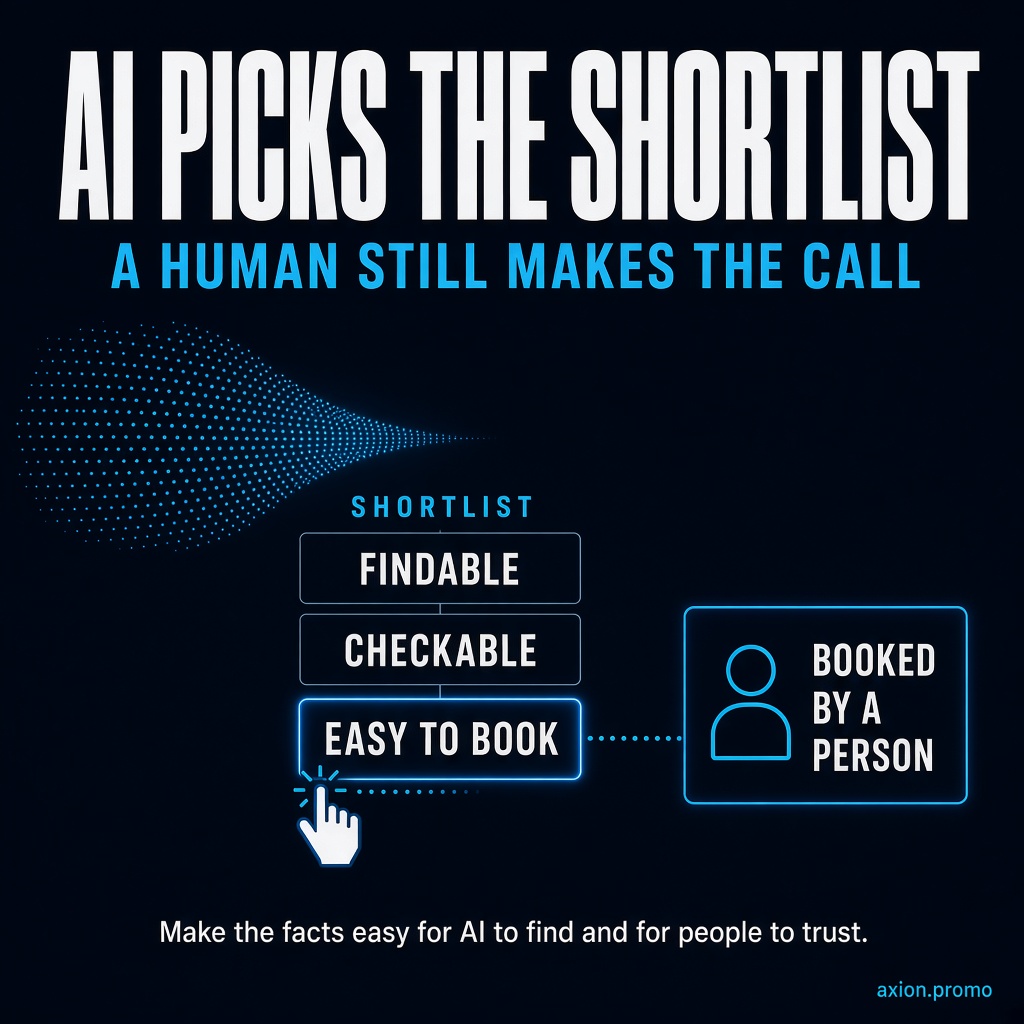
Short answer: AI agents are not booking many customers yet. They are deciding who gets considered. This week, Airbnb said traffic from AI assistants is "very non-material," as Craig Shapiro summarized from Brian Chesky's earnings call. At the same time, Kevin Indig's analysis of 200 software buyers found that AI added a new vendor in about two out of three buying conversations. So the agent isn't the buyer. It builds the shortlist. Your job is to get on that list, hold up when the buyer checks you, and be easy to book when a person makes the call.
AXION did not produce any of the research below. Each finding is credited to the person who published it, with a link to the original post.
Key takeaways
- Agent bookings are close to zero for now. Airbnb, a large Spanish marketplace and a set of Shopify stores all report very little revenue that agents completed themselves.
- Agent influence is real. AI brings up vendors buyers had not considered, and buyers lean on it to compare price, features and fit.
- Three jobs matter: be findable (on the shortlist), be checkable (the facts hold up when someone evaluates you) and be easy to book (a clear official page where a person acts).
- Don't spend on "agent checkout" yet. Spend on the facts and proof AI repeats when it builds the list.
What happened this week
Airbnb: people still want to browse. In Craig Shapiro's notes on Brian Chesky's earnings call, which drew close to a million views, Airbnb reported about 500,000 bookings a day and "very non-material" traffic from AI assistants. The average user looks at dozens of listings and 25+ photos, 90% message the host, and 80% of travelers say they like doing their own research. That is a company with every reason to want agents to work, saying its customers want to stay in control of the final choice.
Ecommerce: agent checkout is at or near $0. Lily Ray shared Gagan Ghotra's Shopify data: his ecommerce clients average more than $100K a month in revenue from Google Search and product listings, and zero through the agentic checkout channel. Replying to Lily, Natzir said that at one of Spain's biggest marketplaces, five such visits had reached the final step in six months, with zero transactions. Lily then asked the industry whether anyone is seeing significant purchases from agents yet.
B2B: AI changes who gets considered. Kevin Indig analyzed responses to 13 questions from 200 software buyers surveyed by Wynter. He discloses that he is an investor in Wynter. His finding: AI adds a new vendor in about two-thirds of conversations. He also notes that buyers use AI heavily to evaluate price, features and integrations. If the AI can't find that information about you, there is a high chance you drop out of the evaluation.
Put together: the agent rarely closes the deal, but it often decides who is in the running.
What this means for a professional-services firm
Picture a business owner asking ChatGPT or Google's AI Mode: "Who are the best estate-planning attorneys near Edina for a blended family?" or "Which Minneapolis accounting firms handle construction job costing?"
Today the AI rarely books the appointment. What it does is:
- Name three to five firms. Some of them the person had never heard of.
- Compare them. It covers specialties, experience, reviews, rough cost and how the process works.
- Hand the decision back to a person. That person reads your bio, checks your reviews and calls or books.
Each step is a place you can win or lose. The firm that gets named, compares well and has an obvious next step gets the call. The firm that ranks well on Google but is missing from the AI answer may never be considered.
AXION Productions runs this kind of check for firms in the Twin Cities: who AI names, which sources it cites, and what to fix first.
The three jobs: findable, checkable, easy to book
1. Be findable: get on the shortlist
AI builds its list from what other sources say about you, not mainly from your homepage. Your own site is often the weakest source AI cites about you.
- Get specific about what you do. "Estate planning for blended families in the west metro" is easier for AI to repeat than "full-service law firm."
- Earn mentions where AI looks. That means reviews, local press, association directories, partner pages, podcasts and interviews. Here is where AI gets its answers about Minnesota businesses.
- Check where you stand today. Run the free self-audit with the questions your buyers actually ask.
2. Be checkable: survive the comparison
Indig's point is the one most firms miss. Buyers use AI to evaluate you, not only to find you. If the facts aren't out there, you lose on the comparison.
- Publish the answers buyers compare on. Who you work with, how the process works, typical timelines and honest cost ranges or what drives cost.
- Keep facts consistent everywhere. Use the same name, services, location and credentials on your site, Google Business Profile, LinkedIn and your ChatGPT business profile.
- Show the people. Partner bios, and video of the partners explaining real client questions, make you easy to trust. They also give AI more to cite. This is why we build authority video for founder-led firms.
- Watch what AI says about your principals. A wrong or outdated fact in an AI answer can cost you the call before you know it happened. That is reputation work now.
3. Be easy to book: own the moment a person acts
When the person is ready, they want one clear place to act, and Google wants to send them there. Alex Groberman summarized Google's October announcement: more clickable source links inside AI answers, shown higher up, plus a test of a section near the top that highlights one or two official websites when they are the best place to complete a task.
- Make one page the obvious place to book. A clear consultation or contact page that says who it's for, what happens next and how fast you respond.
- Keep the path short. Use a phone number, a booking link and a form that takes under a minute. No hunting.
- Make the page match the AI answer. If AI says you handle construction job costing, the page a person lands on should say so in the first line.
What not to do yet
Don't rebuild your intake around AI agents completing bookings on their own. The data this week says that isn't where the money is today. Put that budget into the facts, proof and third-party mentions AI uses when it builds the shortlist. When agents do start booking at scale, they will draw on the same signals.
A 30-minute check you can run this week
- Ask ChatGPT, Google AI Mode and Perplexity three questions a real client would ask. Write down who gets named.
- For each firm named, note why the AI says it picked them (specialty, reviews, location, cost).
- Ask the same tools about your firm by name. Note anything missing, outdated or wrong.
- Fix the top gap first. That might be a missing specialty page, an outdated bio, thin reviews or a contact page that buries the next step.
If you want the bigger picture, read how AI agents choose who gets found and the 7 signals that tell ChatGPT to cite you.
FAQ
Are AI agents booking appointments for law, accounting or advisory firms? Rarely, based on what's public this week. The strongest public data points (Airbnb's earnings call and ecommerce checkout data shared by Lily Ray, Gagan Ghotra and Natzir) show very little agent-completed revenue. Agents are mostly used for research.
Then why should a firm care about AI search now? Because AI is shaping who gets considered. Kevin Indig's analysis of Wynter's survey found AI adds a new vendor in about two-thirds of buying conversations. If you're not in that answer, you're not in the running.
Is this only true for software buyers? Indig's data is from software buyers. The same pattern shows up in travel (Airbnb) and ecommerce. We think it applies to professional services too, but treat it as a pattern to test in your own market, not a proven number for your industry.
What's the single best first step? Run the self-audit and fix the most important missing or wrong fact about your firm.
AXION.productions · Minneapolis
Get on the shortlist, and hold up when buyers check you.
AI agents are deciding who gets considered. We'll run the questions your buyers ask and tell you whether you show up, and what to fix so you do.
Book a Free 15-Min AI Visibility CallFree · No obligation · No sales call required
Learn more: AI search optimization in Minneapolis · B2B AI search
Sources
- Craig Shapiro (@cshapiro), notes from Brian Chesky's Airbnb earnings call, Nov 6, 2026.
- Kevin Indig (@Kevin_Indig), analysis of 200 software buyers' responses from Wynter (disclosed investor), Nov 9, 2026.
- Lily Ray (@lilyraynyc), on agentic commerce performance, Nov 9, 2026 (follow-up).
- Gagan Ghotra (@gaganghotra_), Shopify agentic sales channel data, Nov 9, 2026.
- Natzir (@natzir9), Spanish marketplace agent data, Nov 9, 2026.
- Alex Groberman (@alexgroberman), summary of Google's AI search source-link changes, Nov 10, 2026.