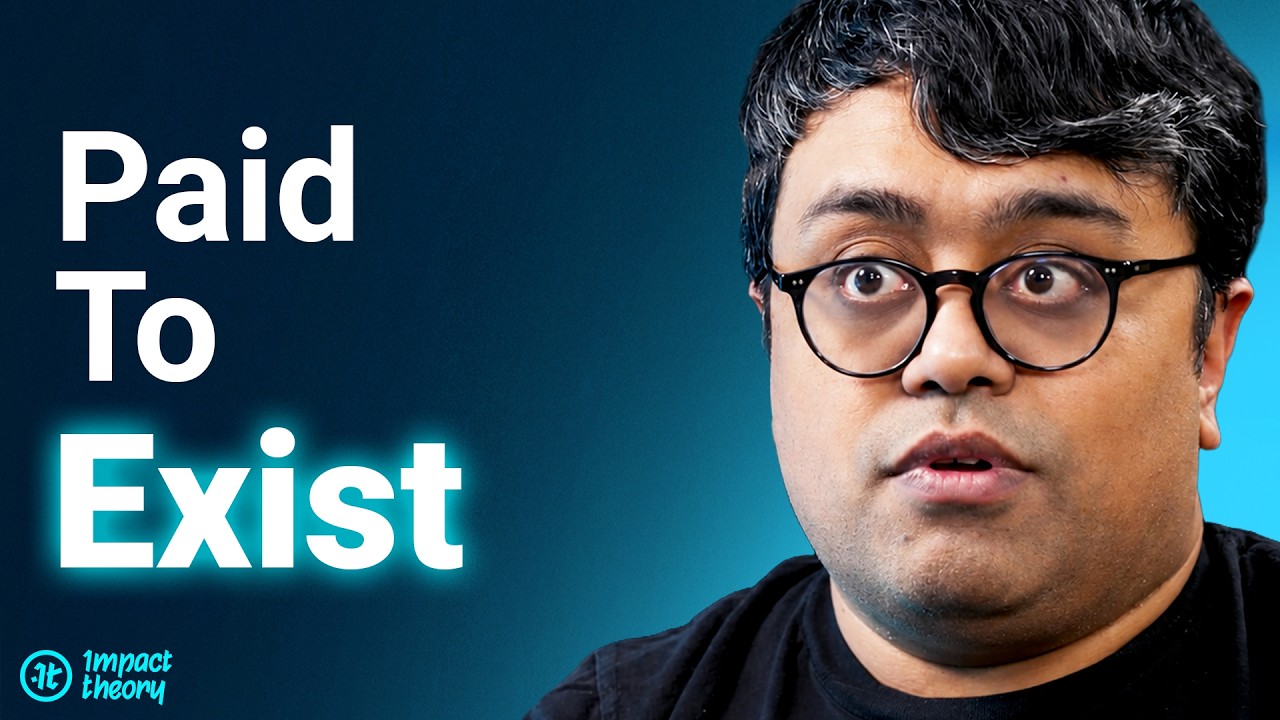
Takeaways from Tom Bilyeu's Impact Theory interview with Emad Mostaque, founder of Intelligent Internet and author of The Last Economy.
Every few years, one conversation compresses a whole debate into a single uncomfortable sentence. In this one, Emad Mostaque said it in the first minute: "We've got about two years before [the value of human cognition] goes negative. We're the dumbest people on the team."
Nobody has to agree with that timeline. But the reasoning behind it is worth understanding, because it explains why he thinks the standard answer to AI job loss, universal basic income, doesn't work the way people assume.
Here are the realizations that stuck with us.
1. The bottleneck is no longer the machine. It's us.
Mostaque's core claim is simple: once AI is competent enough, a team of thousands of agents coordinating perfectly at a thousand times human speed doesn't need to wait for you. "If they're waiting on you, you are the bottleneck."
He's careful about what changed. Early AI was easy to spot because it was half right, and the wrong half was the interesting part. His argument is that the newest models have stopped dropping the ball. That distinction matters. In his words, what hits people economically isn't superintelligence. It's competent intelligence: a model you can trust to do what you asked without making things up.
The realization: the threshold that matters is not "smarter than the best human." It is "reliable enough that you stop checking its work."
2. Cheaper beats smarter
One of the more practical points: once a model clears a certain capability floor, the race shifts from the frontier to cost. Mostaque described a model that once cost a fortune to run now fitting on a phone-class chip, and argued that equivalent performance should get roughly 100 times cheaper within a year.
Whether or not you buy the exact figure, the direction is the point. Capability that is expensive is a project. Capability that is nearly free is a default.
The realization: don't plan around what AI costs today. Plan around what it costs when everyone can afford a thousand agents.
3. Your job is a bundle of tasks. Test them.
This was the most actionable idea in the episode. Mostaque suggested taking your job and breaking it into tasks, each with an input and an output. Give the input to a leading model. If its output is as good as yours, that task is at risk.
Then flip it. The tasks that drained you are the ones to automate first, which frees you to do the parts that still need judgment, or to build something of your own.
The realization: the useful question isn't "will AI take my job?" It's "which of my tasks have I never tested against it?"
4. Use it every day, or fall behind people who do
Mostaque's advice for the next two years was blunt: use AI daily, "training as if you're coming for a marathon." His reasoning is that you only know which tool is strong at what by pushing on them. People who aren't using it don't just miss productivity. They lose the ability to see where the edge is.
He also described the economy sorting into groups: people who use AI, people who own the infrastructure (chips, data centers, robots), and everyone else.
The realization: the gap that opens first won't be between humans and machines. It will be between humans who practiced and humans who didn't.
5. Why he says UBI doesn't add up
This is the part the title refers to. His argument was arithmetic. He put the total US tax base at around $5 trillion and said that a poverty-level UBI of roughly $16,000 per person would cost about $5.1 trillion a year. In other words, the whole tax base, for one program.
Other fixes get the same skeptical treatment. A token tax collapses if the price of tokens falls toward zero. A robot tax runs into the fact that robots are getting cheap.
What he thinks could work instead is a different flow of money entirely: a system where people are paid for being human, and the "intelligence economy" is what pays them. He was candid that this is one of the only workable options he sees, not a solved design.
The realization: the debate about how much to pay people skips the harder question of where the money comes from when labor is no longer the source.
6. Money was never just about survival
Host Tom Bilyeu pushed back on a pure handout model, and the exchange was one of the best moments. His point: humans have a drive to make progress toward a goal and to acquire resources, and removing that doesn't produce contentment. It produces disease and, eventually, violence.
Mostaque agreed with the problem and pointed to what happens in resource-rich states that pay citizens for little work: stagnation. His concern is that AI breaks the link between effort and reward "for the first time ever."
Both of them kept returning to the same ingredients for a workable future: status you can earn, an identity that isn't just your job, and a way to progress.
The realization: a society can feed everyone and still fail if it gives people nothing to strive for.
7. Ownership is the real lever
If wages stop being the main way to build wealth, ownership is. Mostaque's proposal is locally owned AI institutions, structured something like a credit union, where residents hold the equity, with a share set aside for children. He also floated ideas like a citizen service corps as a source of status and purpose.
You don't have to endorse the specifics to take the principle: whoever owns the AI that manages your schedule, your health decisions, and eventually public services holds enormous power over your life. He called the alternative "cognitive colonialism."
The realization: the question isn't only who has the best AI. It's who the AI works for.
8. The last piece of advice isn't technical
Asked for one final thing to keep in mind, Mostaque didn't say a tool or a skill. He said build stronger communities. Many of us live far from family and neighbors, and he expects that support structure to matter whatever happens.
The realization: in a world of infinite capability, trust between people becomes the scarce resource.
What to take from it
Whether the clock runs out in two years or ten, the questions Mostaque raised are the same ones every business and professional faces right now:
- Which of your tasks would you trust an AI with today?
- Where do you own something, rather than rent your time?
- Who do you rely on that would still be there if work changed?
If you're building a brand, a practice, or a company, the second question is the one to act on first. Original, human voices on camera, with real expertise and a real point of view, are exactly what you can own, and what can't be generated from nothing.
Source
- Tom Bilyeu (Impact Theory), "Forget UBI. You'll Get Paid Just for Being Human," interview with Emad Mostaque. Watch on YouTube: https://www.youtube.com/watch?v=WsdcF7EEvhM
- Guest: Emad Mostaque, founder of Intelligent Internet and author of The Last Economy.
All quotes and figures above come from the interview. This post is our summary and commentary.