Short answer: "What's In The Silver Case?" was a month-long, $25,000 scavenger hunt across Los Angeles in October 2026. Its first clue was hidden inside a movie, the black-and-white noir The Man With the Silver Case by writer-director Colin Best. The contest was designed by David Soltani of DSo Consulting, with PR by Thelemata. It was reported by Kait Shea at Event Marketer on November 9, 2026. AXION did not create, run, or take part in this campaign. This is a reported case study: what happened, who made it, and what a business owner or marketer can use from it.
The lesson fits in one line: hide the way in inside the thing you are selling, so playing the game means using the product.

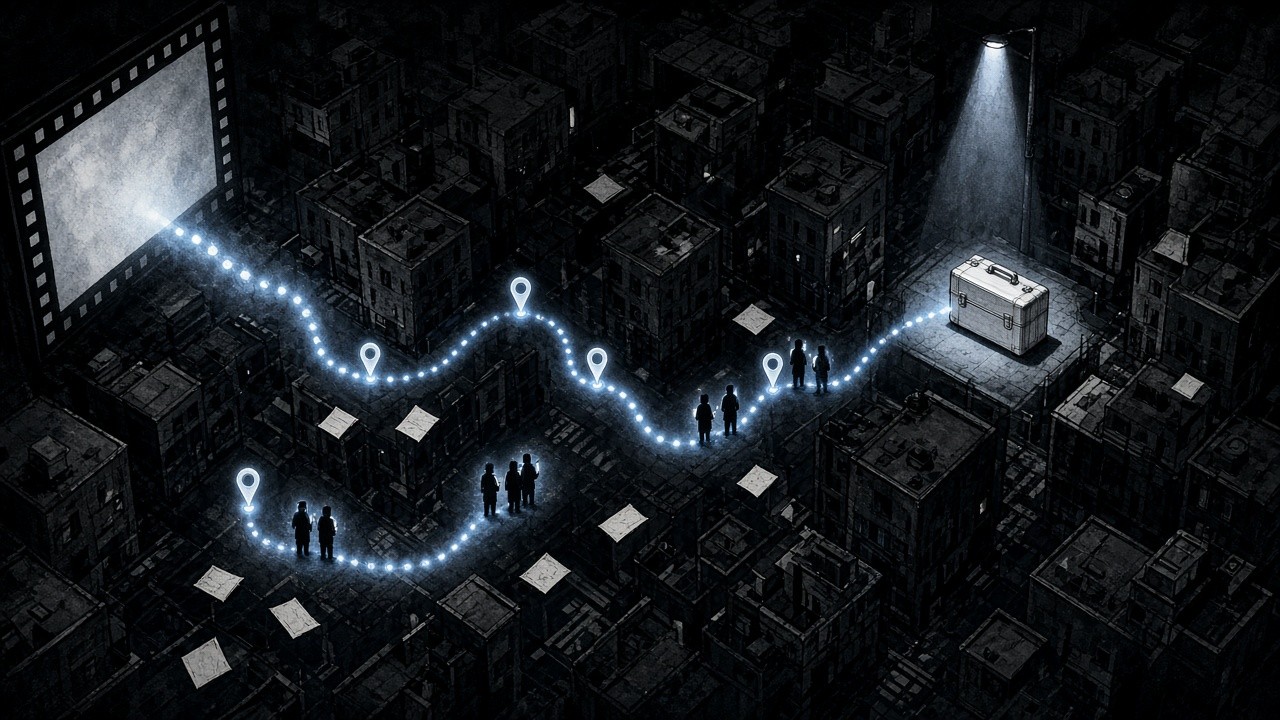
Original illustration of the idea, made for this article. It is not a photo of the actual campaign and does not show the real creative.
Key takeaways
- The entry ticket was the product. You could not join the hunt without watching the film.
- A free way in kept the door wide open. The film was free on an ad-supported service, and no purchase was required to enter or win.
- Stages with hard caps (300, then 150, then 50) turned a huge online funnel into a small, manageable crowd in person.
- The story walked off the screen. A courier handcuffed to a silver case, straight out of the film, handed out calling cards in the street.
- Creators were the media plan. The campaign says 28 creators turned the hunt into content.
- Study it, do not copy it. A cash contest needs official rules, legal review, permits, and a plan for crowds.
What happened, step by step
The brand. The Man With the Silver Case is a self-funded, black-and-white neo-noir written and directed by Colin Best, starring Stuart Reid, and released by Freestyle Digital Media. In the film, a nameless man in gray delivers a mysterious silver case while handcuffed to it. Ads of the World's case page sums up the problem the campaign had to solve: a noir "with no studio behind it." In other words, no big studio marketing budget.
The hook. The first clue lived inside a scene in the movie. Viewers who spotted it entered the answer at the contest site, lookagain.la, to register. As Nia Bowers wrote in LA Weekly on October 20, 2026, the film was streaming free on Kapang and on Prime Video, so anyone could get in without paying.
The street layer. According to Event Marketer, the in-person campaign started when a messenger in a gray suit, handcuffed to a silver briefcase and followed by men in black suits, walked around L.A. handing out 4,000 calling cards.
The crowd moments. Event Marketer reports that on October 19, about 700 fans who had followed hints online came to the Santa Monica Pier, where creator Braeden Days hosted a themed giveaway event. The next day, cryptic tips brought about 1,000 people to the TCL Chinese Theatre in Hollywood.
The finale. On October 28, players crossed the city to a payphone carrying a recorded message from the film's lead, Stuart Reid. They used it to track down the courier, and the final clue led them to the case. Two players, Jordan N. and Vincent P., won the $25,000.
The numbers, and whose numbers they are
These figures come from the campaign team, as published in Event Marketer's report, the campaign's Ads of the World case page, and the Thelemata press release of November 6, 2026. AXION has not independently verified them.
- About 70 million views across campaign content.
- More than 5,600 registrations, and about 60,000 visits to the contest site.
- About 100,000 views of the film on Prime Video, per Event Marketer. The press release adds about 40,000 on Tubi; the Ads of the World page puts the combined total at more than 140,000.
- 4,000 calling cards handed out, and crowds of about 700 and about 1,000 at two in-person moments.
The view count is the headline, but for a small film the number that matters most is the last one on the list: people actually watched the movie, because that was the only way to play.
Why it worked
1. The game made people use the product. Most contests ask you to follow an account or tag a friend. This one asked you to watch the film closely enough to find a clue. Every registration started with a viewing. The marketing did not point at the product. It ran through it.
2. It removed every excuse not to start. The film was free on an ad-supported service, entry was free, and the official rules say no purchase was needed to enter or win. A big prize with a small first step is a strong combination. The hard part comes later, after people are already hooked.
3. Caps kept a citywide game under control. The official rules set the funnel: the first 300 valid completions of clue 2 advance, then the first 150 of clue 3, then the first 50 of clue 4 become finalists. Registration was open to anyone, but the in-person stages were small by design. That also created urgency, because spots ran out. Ads of the World notes that players could watch the stages fill up live on the site.
4. The story became a real thing on the street. A courier handcuffed to a silver case is a strange sight anywhere. It is also exactly what happens in the film. People who had never heard of the movie saw a piece of it walk past them, and the calling card told them where to go next.
5. Creators carried it. The campaign credits 28 creators with more than 35 million combined followers, led by Braeden Days, who turned himself into a live target players had to find and tag. Each creator's video was both an ad and an invitation. As David Soltani of DSo Consulting put it in the press release: "people will invest deeply in a story when you give them a meaningful role in it."
Want to know how visible your business is in AI search? Book a free AI visibility check with AXION Productions.
How to use this lesson in your own business
You do not need $25,000 or Hollywood Boulevard. You need the same structure, scaled to your budget and your town.
Hide the first clue in your product. A restaurant can put it on the menu. A retailer can put it in the window display. A software company can hide it in the product tour. A brewery can print it under the label. Whoever finds it has already spent time with what you sell.
Size the prize to the effort. Locally, the prize can be a year of free coffee, a private event, or a product people actually want. What matters is that it feels worth the chase.
Build a funnel with caps. Let anyone start online. Make the later steps in person, and limit how many people can move forward each round. That keeps costs, crowds, and staffing predictable.
Turn one element of your story into something physical. A character, a prop, a vehicle, a recognizable object. It should make sense without explanation and be easy to film.
Recruit local creators as players, not just promoters. A creator who is part of the game produces better content than one reading a script. Disclose paid partnerships clearly.
A Midwest example: a Minneapolis bakery hides a riddle in the design on its seasonal box. Solving it unlocks a map of three partner shops along a walkable street, each with a small, capped number of stamps. The first ten people to collect all three win a year of birthday cakes. Same structure, a fraction of the cost.
What to check before you try a hunt
The source reports do not describe the campaign's permits or safety planning, so this is general guidance, not a description of how this team handled it:
- Contest law. Prize promotions are regulated. The Silver Case hunt had a sponsor (MWSC, LLC), an administrator (Promosis, Inc.), official rules, eligibility limits, and a free way to enter. Have a lawyer review yours.
- Crowds and public space. If hundreds of people may show up at one spot, talk to the property owner and the city first, and plan for safety, staffing, and neighbors.
- Fair play. Clear rules on one entry per person, no bots, and how winners are verified protect you when a real prize is on the line.
- Honest numbers. Report results the way they were measured, and say where a figure came from.
One hunt is a spike, not a strategy
A great hunt creates a month of attention. Being remembered for years takes steady, repeated presence. For why that matters more than one loud moment, read why the best-kept secret in your market loses to a louder competitor. For a Minneapolis or Minnetonka business, a smaller version, such as a few clues hidden around your neighborhood with a prize at your door, is a low-cost way to test the idea first. The Silver Case hunt also shows how much a campaign leans on video: creator clips, live streams, and short-form recaps did most of the distribution. That is the kind of steady short-form output our video marketing work is built around, and one long video can feed dozens of clips.
For another film campaign that turned its premise into a public stunt, see Netflix and Extra Credit's billboard house in our guerrilla marketing examples roundup. For a product demo you can touch, see Hada Labo's Bouncy Billboard.
Want an idea like this for your business?
If you run a company in Minneapolis or the Midwest, AXION Productions can look at how visible you are in AI search and talk it through on a quick Zoom. Book a free 15-minute consultation or AI visibility check. We report on work like this — AXION Productions didn't create the campaigns described here.
Full credits
As listed on the campaign's Ads of the World case page:
- Campaign: What's In The Silver Case?
- Film: The Man With the Silver Case
- Writer-Director: Colin Best
- Agency: DSo Consulting (David Soltani, Managing Partner; Lauren Velez, Operations Associate)
- Design and campaign assets: Kyle Noriheim
- Field production: Nik Shaw, Producer
- PR: Thelemata (Zac Hunter)
- Talent: Braeden Days
Event Marketer also lists RE:ANIME as a campaign partner.
Reported by Kait Shea, Event Marketer, November 9, 2026. Additional coverage by Nia Bowers, LA Weekly, October 20, 2026. Results figures from the campaign's press release by Thelemata, November 6, 2026. Contest structure from the official rules.
FAQ
Did AXION make the Silver Case hunt? No. The campaign was for the film The Man With the Silver Case by Colin Best, designed by DSo Consulting, with PR by Thelemata. This article reports on it, based on the sources linked above.
When and where did it happen? In Los Angeles in October 2026. Registration opened October 6, and the winners found the case on October 28.
How did people enter? By watching the film, finding the clue hidden in it, and entering the answer at lookagain.la. Entry was free and no purchase was required.
How many people took part? The campaign reports more than 5,600 registrations. In-person stages were capped at 300, then 150, then 50 finalists.
Were the 70 million views verified? The figure comes from the campaign team and was published by Event Marketer and in the campaign's press release. AXION has not independently verified it.
Is a scavenger hunt guerrilla marketing or experiential marketing? Both. It uses public space and surprise like guerrilla marketing, and it gives people a role to play like experiential marketing.
Can a small business run a scavenger hunt? Yes, at a smaller scale. Hide the first clue in your product, keep entry free, cap the in-person stages, and get legal and property permissions first.
Keep reading
- Guerrilla Marketing Examples Worth Studying: Four Campaigns and Why They Worked
- Hada Labo's Bouncy Billboard: A Tactile Billboard That Lets People Feel the Product
- Deepgram's Giant Deviled Eggs: How to Make an Invisible Product Memorable
- Krispy Kreme's Doughner Kebab Van: How to Hijack a Ritual People Already Have
- The Body Shop's Cookie Billboard: How Taste Stood In for Scent