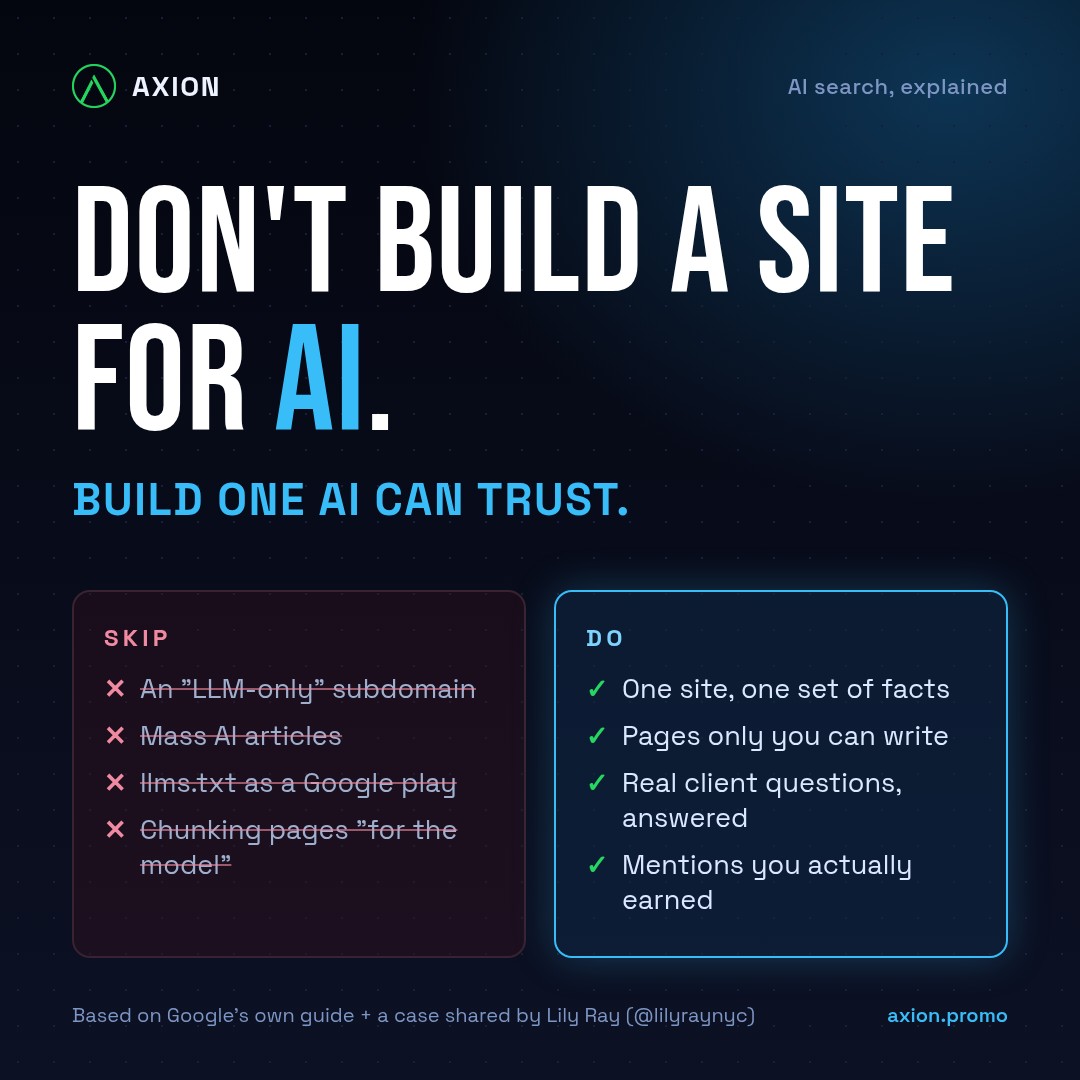
Short answer: Don't build a separate website, subdomain or content hub "for AI." This week, SEO consultant Lily Ray shared the Google traffic chart of a site that launched an LLM-only subdomain full of AI-generated articles. After a spike in late September, its traffic fell off a cliff by early November. Google's own guidance explains why that kind of shortcut doesn't work: Google Search ignores llms.txt and "AI text files," you don't need to chunk or rewrite pages for AI, and churning out extra pages to manipulate AI answers falls under its scaled content abuse spam policy. Build one site for people, with facts AI can check.
AXION did not find this case or produce this research. The example and the Business Hub finding below are Lily Ray's, linked to her original posts. The guidance comes straight from Google Search Central.
Key takeaways
- A subdomain of AI articles written "for LLMs" lost most of its estimated Google traffic within weeks. That's the example Lily Ray shared.
- Google Search ignores llms.txt and similar files. Google says they will "neither harm nor help" your rankings.
- You can skip chunking, rewriting for AI and chasing fake mentions. Google lists all three as things you don't need to do.
- Making a page for every possible AI question is a spam risk. Google says doing it to manipulate AI answers violates its scaled content abuse policy.
- Your real website is still your anchor. In ChatGPT's new Business Hub, Lily Ray noticed a "mention" only counts when ChatGPT mentions your website.
What happened
On November 11, Lily Ray posted that a site she has been tracking, which she called "one of the biggest losers of an AI content case study," had launched "an LLM-only subdomain of their site, with tons of AI-generated articles presumably written for agents/LLMs." Her post showed how it was going in Google Search: an SEO tool's estimate of the subdomain's pages and traffic climbing in late September, then dropping sharply into November.
Someone in the replies asked whether the subdomain blocked Googlebot. Her answer: "Nope, explicitly allowed." So Google could crawl the pages. It just didn't keep sending them traffic.
Lily didn't name the site, and we won't either. The lesson is the pattern, not the company.
What Google says you can skip
Google published a guide to optimizing for generative AI features in Search (last updated July 10, 2026). It includes a mythbusting section with things site owners can ignore for Google Search:
- llms.txt and other "special" files. "You don't need to create new machine readable files, AI text files, markup, or Markdown to appear in Google Search (including its generative AI capabilities), as Google Search itself doesn't use them." Keeping one for other tools is fine. Google says it "will neither harm nor help" you in Google Search.
- Chunking content. "There's no requirement to break your content into tiny pieces for AI to better understand it."
- Rewriting for AI. "You don't need to write in a specific way just for generative AI search."
- Inauthentic mentions. Seeking them "isn't as helpful as it might seem."
The technical bar is short. Google's page on AI features and your website says a page must be "indexed and eligible to be shown in Google Search with a snippet," and "there are no additional technical requirements."
Where the "for AI" shortcut crosses a line
The same guide warns against creating separate content for every variation of how people might search, including the "fan-out" questions AI tools run in the background. Doing that "primarily to manipulate rankings or generative AI responses in Google Search violates Google's scaled content abuse spam policy."
Google's spam policies define scaled content abuse as "many pages... generated for the primary purpose of manipulating search rankings and not helping users," "no matter how it's created." The first example listed: "Using generative AI tools or other similar tools to generate many pages without adding value for users."
That describes an LLM-only subdomain stuffed with AI articles almost word for word.
Why your real website still matters, even in ChatGPT
The other side of this story comes from ChatGPT. When OpenAI opened its new Business Hub, Lily Ray noticed that OpenAI only counts a "mention" when ChatGPT mentions a business's website. The brand name alone doesn't count. Her guess: it avoids confusion with brand names that could refer to something else.
In plain words, your website is how AI tools tell which business is yours. It should be the clearest, most complete version of your firm on the internet, not a copy written for machines. If you haven't set up your ChatGPT profile yet, see how to claim your business in ChatGPT.
What to do instead: a 5-step plan
- Keep one site and one set of facts. Put your firm's name, services, city and who you serve on the first screen. Use the same wording on Google Business Profile, LinkedIn and your ChatGPT business profile.
- Write the pages only you can write. Google's guide contrasts commodity content, like "7 Tips for First-Time Homebuyers," with first-hand pages that go beyond common knowledge. For a law firm, that might be "What actually slows down a probate case, from the attorney who files them." For an accounting firm, "The three questions we ask every new client in January."
- Answer the questions clients ask on the phone. Use plain headings and short sections, on your real pages. You don't need a special format for AI. Clear writing for people already works.
- Earn mentions you didn't write. Reviews, local press, podcasts, directories and partner pages carry weight that your own pages can't. Here's where to build those mentions first.
- Measure what matters. Check Google's AI impressions in Search Console (here's how to read that report) and run a monthly ChatGPT self-audit with the questions your buyers ask.
Before you buy an "AI content" package, ask these 5 questions
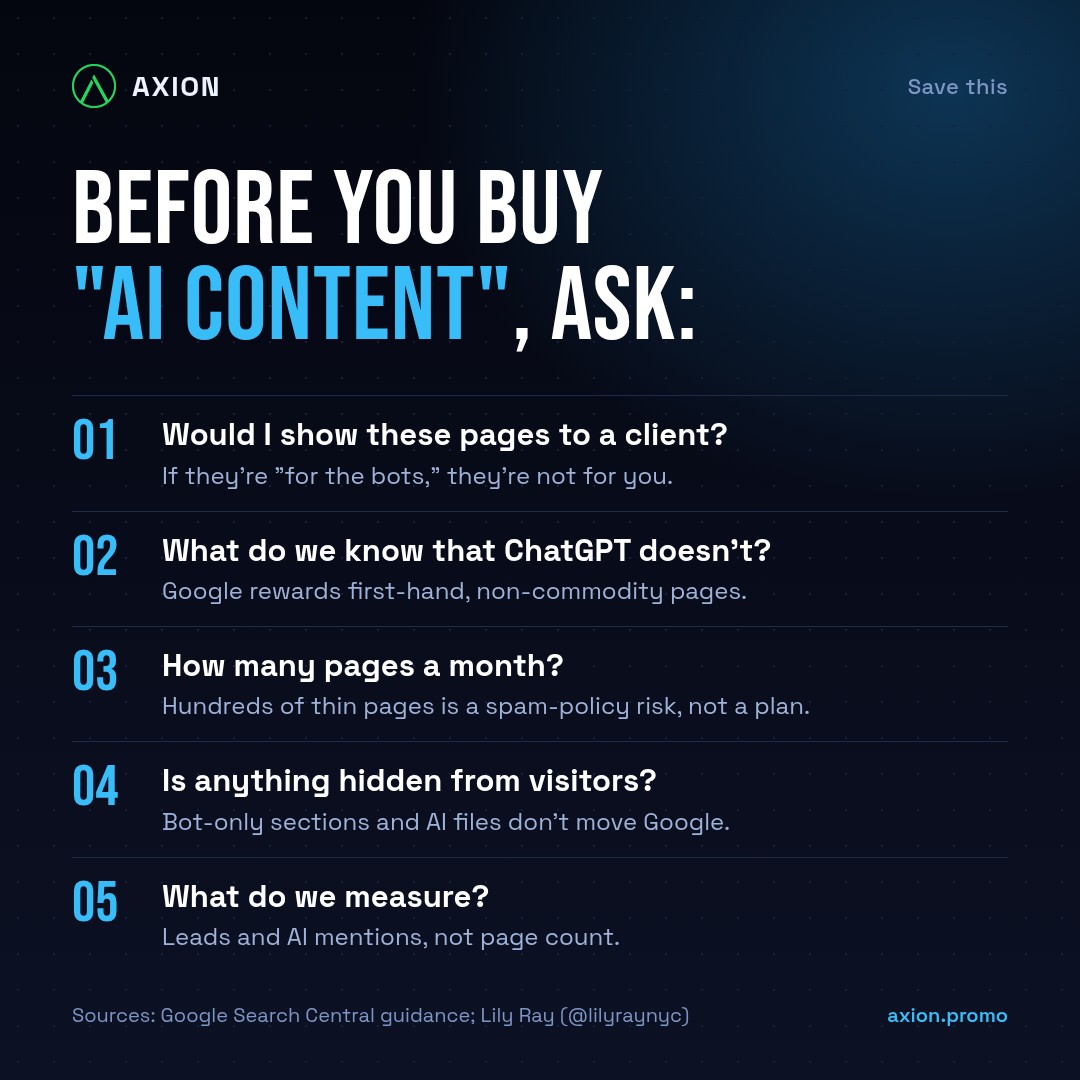
- Would I show these pages to a client? If they're "for the bots," they're not for you.
- What do we know that ChatGPT doesn't? If the answer is "nothing," the pages add nothing.
- How many pages a month? Hundreds of thin pages is a spam-policy risk, not a strategy.
- Is anything hidden from visitors or only meant for bots? Separate AI files and bot-only sections don't help you in Google Search.
- What will we measure? Leads, calls and whether AI names you. Not page count.
FAQ
Should I delete my llms.txt file? No need. Google Search ignores it, and other tools may read it. Just don't pay for it as a Google strategy.
Is AI-assisted writing against Google's rules? No. Google's policy targets pages made at scale to manipulate rankings without helping people, "no matter how it's created." An expert using AI to draft a page they then check and improve is a different thing.
Does this mean SEO and AI search are the same thing? Mostly, for Google. We covered where they differ in Google says GEO is just SEO.
AXION.productions · Minneapolis
Show up in AI answers without shortcuts that can backfire.
We'll check what ChatGPT, Perplexity and Google AI already say about your firm, using your real website and the sources they actually cite.
Book a Free 15-Min AI Visibility CallFree · No obligation · No sales call required
Learn more: AI search optimization in Minneapolis · AI SEO and GEO work
Sources
- Lily Ray (@lilyraynyc), LLM-only subdomain traffic, Nov 11, 2026 (reply on Googlebot access).
- Lily Ray (@lilyraynyc), on how ChatGPT's Business Hub counts mentions, Nov 10, 2026.
- Google Search Central, Google's guide to optimizing for generative AI features on Google Search, last updated July 10, 2026.
- Google Search Central, AI features and your website.
- Google Search Central, Spam policies for Google web search.